Hair (disambiguation)
”’Hair type”’ refers to the classification of human hair based on its texture, curl pattern, and other intrinsic properties. While there is no single universally accepted scientific classification system, various models have been developed to categorize hair, primarily for the purpose of guiding hair care, styling, and product selection. These systems typically consider factors such as the shape of the hair follicle, the distribution of keratin within the hair shaft, and the overall curl pattern.
Understanding one’s hair type is crucial for effective hair management, as different hair types have unique needs regarding moisture, protein, and styling techniques.
== Biological Basis of Hair Type ==
The primary determinant of hair type is the shape of the hair follicle from which the hair strand grows.
* **Straight hair** typically emerges from a round hair follicle. The hair shaft itself has a circular cross-section, allowing for an even distribution of keratin proteins, which results in a smooth, straight strand.
* **Wavy hair** originates from oval-shaped follicles. The oval cross-section causes keratin to be distributed unevenly, leading to a gentle S-shaped wave pattern.
* **Curly hair** grows from more flattened, elliptical follicles. This highly asymmetrical cross-section causes keratin to accumulate more on one side of the hair strand, creating a pronounced curl or spiral pattern.
* **Coily/Kinky hair** emerges from very flat, ribbon-like follicles. The extreme flatness of the follicle and the highly asymmetrical distribution of keratin result in very tight, often Z-shaped or S-shaped coils that can be densely packed.
Beyond follicle shape, other biological factors influence hair type:
* **Genetics:** Hair type is largely hereditary. Specific genes, such as EDAR and FGFR2, have been identified as playing a role in determining hair texture, particularly in East Asian and European populations.
* **Keratin Distribution:** The way keratin proteins are arranged and bonded within the hair shaft significantly impacts its shape and elasticity. Disulfide bonds between keratin molecules contribute to the hair’s structural integrity and its ability to hold a curl.
* **Hair Growth Angle:** The angle at which the hair emerges from the scalp also contributes to its overall appearance and direction.
* **Hormonal Influences:** Hormonal changes (e.g., during puberty, pregnancy, menopause) can sometimes alter hair texture, though these changes are typically less dramatic than genetic predispositions.
* **Environmental Factors:** Humidity can temporarily alter the appearance of hair, particularly wavy and curly types, by affecting the hydrogen bonds within the hair structure.
== Classification Systems ==
Several systems exist to categorize hair types, with the Andre Walker Hair Typing System being the most widely recognized and utilized.
=== Andre Walker Hair Typing System ===
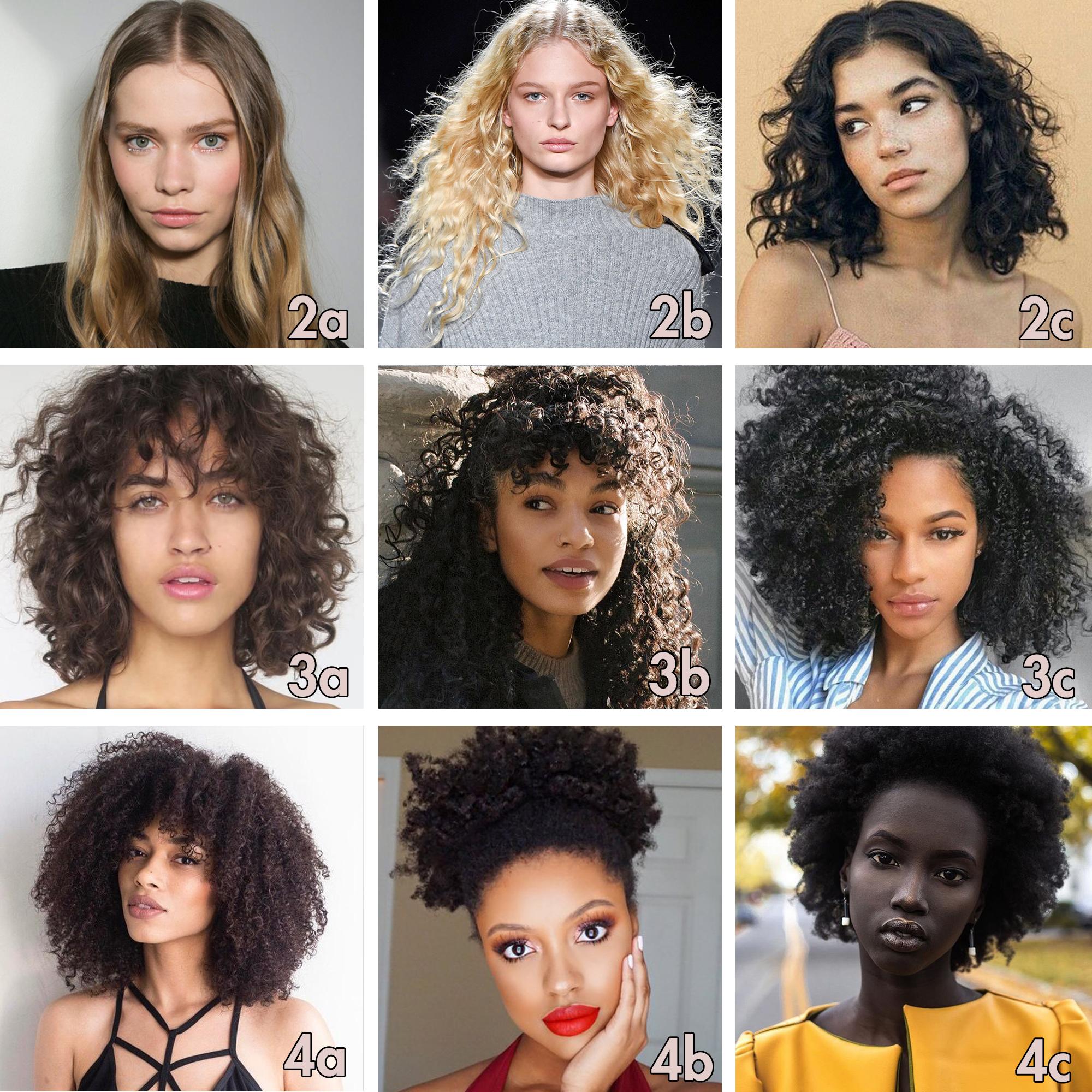
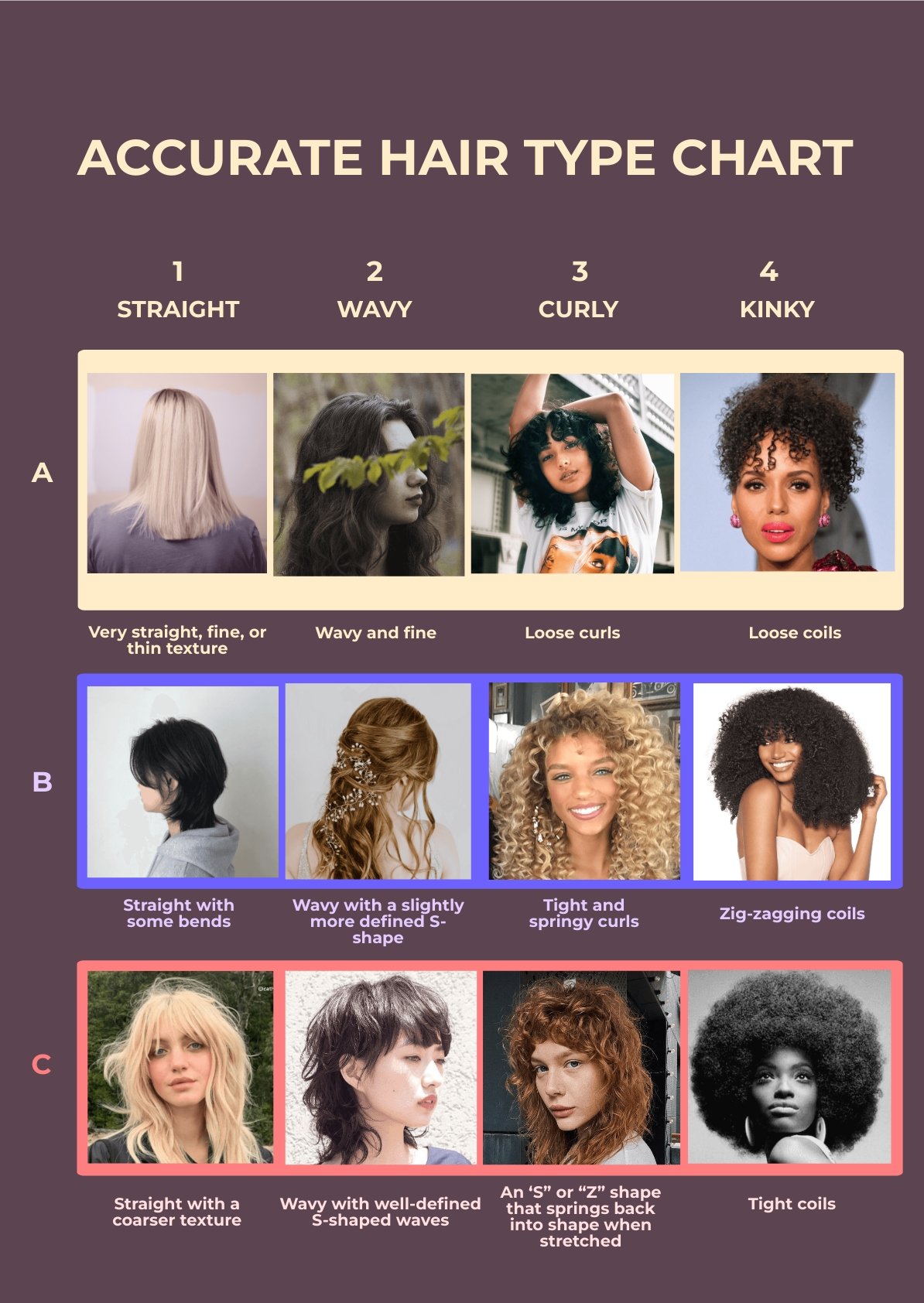
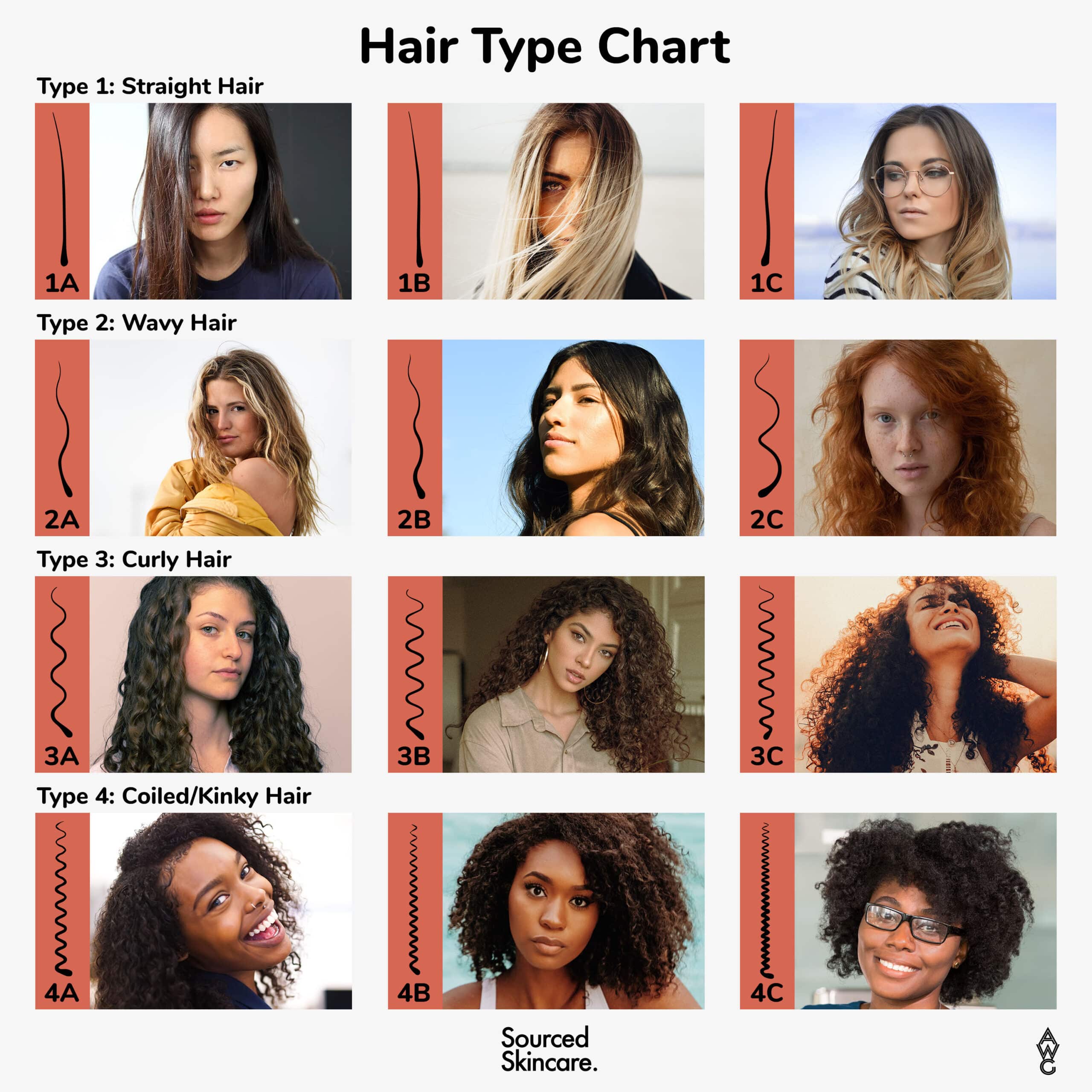
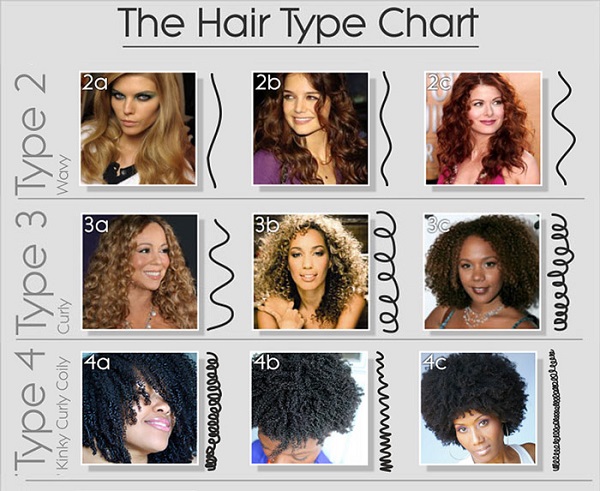
Developed by celebrity hairstylist Andre Walker, this system categorizes hair into four main types (1, 2, 3, 4), with sub-categories (A, B, C) to denote increasing tightness of the curl pattern within each type. While widely adopted, especially in the beauty industry, it has faced criticism for its perceived oversimplification and its focus on curl pattern over other important hair properties.
==== Type 1: Straight Hair ====
Type 1 hair is characterized by its lack of natural curl. The strands are typically smooth, shiny, and can be resistant to curling. It tends to be oily at the roots due to the natural oils (sebum) easily traveling down the straight shaft.
* ”’1A:”’ Extremely straight, fine, and thin. It is very soft, shiny, and often struggles to hold a curl. It can appear flat and lacks volume.
* ”’1B:”’ Straight with medium texture. It has some body and can hold a curl better than 1A. It is the most common straight hair type.
* ”’1C:”’ Straight with coarse texture. It is thick, often resistant to curling, and may have a slight bend or subtle wave, especially in humid conditions. It can be prone to frizz.
==== Type 2: Wavy Hair ====
Type 2 hair has a natural S-shaped wave pattern. It is typically thicker than straight hair and ranges from loose, barely-there waves to defined, beachy waves. It can be prone to frizz and requires products that enhance waves without weighing them down.
* ”’2A:”’ Fine, barely-there waves that are easily straightened or curled. The waves are loose and spread out, often starting below the crown. It tends to be soft and shiny.
* ”’2B:”’ Medium-textured waves that are more defined than 2A, forming a distinct S-shape. The waves start closer to the crown and can be prone to frizz. It has more volume than 2A.
* ”’2C:”’ Coarse, defined waves that are closer to curls. The S-shape is pronounced and starts at the roots. It has significant volume and is highly susceptible to frizz. It can be challenging to manage without proper hydration.
==== Type 3: Curly Hair ====
Type 3 hair forms distinct, well-defined curls that range from loose spirals to tight corkscrews. It is generally voluminous but can be prone to dryness and frizz due to the cuticle not lying as flat as in straight or wavy hair, making it harder for natural oils to travel down the strand.
* ”’3A:”’ Large, loose curls that are well-defined and shiny. The circumference of the curls is roughly the size of a sidewalk chalk stick. It has good elasticity and can be easily stretched.
* ”’3B:”’ Bouncy, springy curls that are tighter than 3A, with a circumference similar to a Sharpie marker. It has significant volume and can be prone to frizz if not properly moisturized.
* ”’3C:”’ Tightly packed, voluminous corkscrew curls with a circumference similar to a pencil or straw. These curls are dense and have a lot of shrinkage (appear shorter than their actual length). It is very prone to dryness and tangling.
==== Type 4: Coily/Kinky Hair ====
Type 4 hair is characterized by very tight, small, and often Z-shaped or S-shaped coils that are densely packed. It is the most fragile hair type due to the numerous bends in the hair shaft, which create points of weakness. Despite its appearance of being coarse, Type 4 hair is often very fine and delicate. It experiences the most shrinkage and requires significant moisture to prevent breakage and maintain health.
* ”’4A:”’ Densely packed, S-shaped coils that are visible to the eye. The coils are springy and have a circumference similar to a crochet needle. It retains moisture better than 4B or 4C but still requires diligent hydration.
* ”’4B:”’ Coils that are less defined than 4A and have a more Z-shaped pattern, bending at sharp angles. The coils are often fine and delicate, leading to significant shrinkage and a cottony texture when dry. It is very prone to dryness and tangling.
* ”’4C:”’ The tightest and most fragile coil pattern. It has no defined curl pattern without manipulation (e.g., twist-outs, braid-outs). The coils are very small, dense, and often resemble a zig-zag pattern. It experiences the most shrinkage and is highly susceptible to dryness, breakage, and tangling. It requires maximum moisture and gentle handling.
=== LOIS System ===
The LOIS system is an alternative classification that attempts to provide a more nuanced description of hair texture, particularly for coily and kinky hair types. It categorizes hair based on its shape, but also incorporates other characteristics:
* ”’L (Bend):”’ Hair with a distinct bend, but no curl or coil.
* ”’O (Loop):”’ Hair with a definite circular shape, forming loops.
* ”’I (Straight):”’ Hair that is completely straight.
* ”’S (Wave):”’ Hair with a clear S-shaped wave pattern.
This system is often combined with descriptors for:
* ”’Texture:”’ Fine, medium, coarse.
* ”’Volume:”’ Low, medium, high.
* ”’Sheen:”’ Low, medium, high.
The LOIS system aims to be more descriptive than the Andre Walker system, especially for complex textures, but it is less widely adopted.
== Key Hair Properties Beyond Type ==
While curl pattern (hair type) is a primary characteristic, other properties significantly influence hair behavior and care needs.
=== Porosity ===
Hair porosity refers to the hair’s ability to absorb and retain moisture. It is determined by the state of the hair’s cuticle layer.
* ”’Low Porosity:”’ The cuticles are tightly packed and lie flat, making it difficult for moisture to penetrate. Products tend to sit on the hair. Hair takes longer to get wet and dry.
* ”’Medium Porosity:”’ The cuticles are slightly raised, allowing for good moisture absorption and retention. This is considered the ideal porosity.
* ”’High Porosity:”’ The cuticles are raised or damaged, allowing moisture to enter and exit easily. Hair gets wet quickly, dries fast, and is prone to frizz and breakage. This can be a result of chemical treatments, heat damage, or genetics.
=== Density ===
Hair density refers to the number of individual hair strands on one’s scalp. It is distinct from strand thickness.
* ”’Low Density:”’ Fewer hair strands, making the scalp easily visible.
* ”’Medium Density:”’ Average number of hair strands.
* ”’High Density:”’ Many hair strands, making the scalp difficult to see.
=== Width/Diameter (Fine, Medium, Coarse) ===
This property refers to the thickness of an individual hair strand.
* ”’Fine:”’ Individual strands are very thin and barely perceptible.
* ”’Medium:”’ Individual strands are neither fine nor coarse.
* ”’Coarse:”’ Individual strands are thick and strong.
=== Elasticity ===
Hair elasticity is the hair’s ability to stretch and return to its original state without breaking. It indicates the strength of the hair’s protein structure.
* ”’Good Elasticity:”’ Hair can stretch significantly when wet and return without breaking.
* ”’Poor Elasticity:”’ Hair breaks easily when stretched, indicating damage or lack of protein.
== Hair Type and Hair Care ==
Understanding one’s hair type and properties is fundamental to developing an effective hair care routine. General principles apply to all hair types, such as gentle handling, avoiding excessive heat, and using appropriate cleansing and conditioning products. However, specific needs vary greatly:
* ”’Straight Hair (Type 1):”’ Tends to get oily quickly. Requires frequent washing with lighter shampoos and conditioners to prevent greasiness and maintain volume. Can benefit from dry shampoo between washes.
* ”’Wavy Hair (Type 2):”’ Prone to frizz. Benefits from sulfate-free shampoos and lightweight conditioners that enhance waves without weighing them down. Scrunching with styling products (mousses, gels) can help define waves.
* ”’Curly Hair (Type 3):”’ Prone to dryness and frizz. Requires moisturizing, sulfate-free shampoos and rich conditioners. Co-washing (conditioner-only washing) is often beneficial. Leave-in conditioners and curl-defining creams are essential. Detangling should be done gently, preferably with fingers or a wide-tooth comb on wet hair.
* ”’Coily/Kinky Hair (Type 4):”’ The most fragile and prone to dryness and shrinkage. Requires maximum moisture, often through deep conditioning, leave-in conditioners, and heavy oils/butters. Low-lather or no-lather cleansers are preferred. Protective styles (braids, twists) help minimize manipulation and breakage. Detangling must be done with extreme care on wet, conditioned hair.
Regardless of type, considering porosity, density, and width allows for further customization of product choice (e.g., heavier products for high porosity/coarse hair, lighter products for low porosity/fine hair).
== Cultural and Social Aspects ==
Hair type is not merely a biological classification; it carries significant cultural and social implications. Beauty standards historically and contemporaneously vary across cultures, often valuing certain hair types over others. This can lead to societal pressures, hair discrimination, and impact self-perception. The natural hair movement, particularly prominent within Black communities, celebrates and encourages the embrace of natural hair textures, challenging conventional beauty norms and promoting self-acceptance.
== See Also ==
* Hair
* Hair follicle
* Keratin
* Human hair color
* Hair care
== References ==
* Andre Walker Hair Typing System: https://andrewalkerhair.com/pages/hair-typing-system (Note: While widely used, direct scientific peer-reviewed sources for the system’s *development* are limited, as it’s a commercial classification).
* Loussouarn, G. (2001). African and European hair: a comparison of their mechanical and morphological properties. *International Journal of Dermatology*, 40(1), 2-6. (For biological differences)
* Robbins, C. R. (2012). *Chemical and Physical Behavior of Human Hair*. Springer Science & Business Media. (For detailed hair structure and properties)
* Adhikari, K., Fontanillas, P., Johnson, N., et al. (2016). A genome-wide association scan in admixed Latin Americans identifies new loci influencing hair color and texture. *Nature Communications*, 7(1), 10473. (For genetic influences)
* The Science of Hair: Porosity, Density, and Elasticity. (Various reputable cosmetology and trichology resources, e.g., National Hair Loss Association, American Academy of Dermatology, professional cosmetology textbooks).
[[Category:Hair]]
[[Category:Human anatomy]]
[[Category:Beauty]]